The fastest way to improve a talk is to hear it the way your audience will. Rehearse out loud, record the run-through, and review it against a short list of things that matter: pace, filler words, pauses, eye contact, and whether each section earns its time. AI feedback makes that review take minutes, and it points to the exact moment each issue happened, so you know what to fix first.
This guide covers a practical rehearsal routine, the numbers worth watching, and how to use Stage Coach, the speech practice tool built into Worth the Pitch, to get a coaching report on every run-through.
Why recorded rehearsal works
Speakers are poor judges of their own delivery in the moment. A section that felt slow is often right on pace, and a transition that felt smooth can hide three filler words in a row. A recording removes the guesswork. You see and hear what the room will experience.
The catch is time. Watching a 30-minute recording closely, with a notepad, takes longer than giving the talk. That is where AI feedback helps: it transcribes the run-through, counts what a coach would count, and turns the recording into a short list of timed notes you can act on the same evening.
What to measure in a practice run
Pace
Many coaches aim for roughly 130 to 160 words per minute in a conference talk. Watch for spikes more than the average. Most speakers rush the same places: data slides, the middle of a long section, and the last two minutes when they sense the clock.
Filler words
"Um," "uh," "so," "basically," and "you know" are normal in conversation. On stage they signal uncertainty, and they cluster where you are least sure of the next line. A count per minute tells you whether you have a habit, and a timeline shows you where it lives.
Pauses
Silence after an important point gives the audience time to absorb it. Rehearsal feedback should show whether you pause after key ideas or rush straight into the next sentence.
Vocal variety
A steady, even voice is tiring to listen to for 40 minutes. Variety in pitch and energy keeps attention and signals which moments matter most.
Eye contact and presence
On camera, eye contact means looking at the lens. In a room, it means finding faces in every section of the audience. An estimate of how often your head and eyes point toward the camera is a useful stand-in, along with notes on posture and gestures.
Structure
Does the opening earn attention in the first 30 seconds? Does each section connect to the promise of the talk? Does the close land, or does it trail off? Structure matters more than any single delivery habit.
A rehearsal routine that fits a busy week
- Full run-through, recorded. Stand up, use your slides or talk map, and deliver the whole talk at full volume.
- Read the report, pick two fixes. Choose the two issues with the biggest payoff. Usually that is one structural fix and one delivery habit.
- Drill the weak sections. Rehearse only the minutes that need work, in short takes, until they feel easy.
- Second full run-through, a day later. Record again and compare. Look for the two fixes first, then anything new.
- Opening and close, memorized. Rehearse your first 90 seconds and your final minute until you can deliver them on autopilot, since nerves peak at the start.
Two fixes per round is plenty. Trying to correct eight habits at once usually makes a talk stiffer. Fix the two that matter most, then record again.
How Stage Coach works
Stage Coach is the rehearsal partner inside Worth the Pitch. It runs in your browser, so there is nothing to install.
- Sign in to your Worth the Pitch dashboard, open the Stage Coach tab, and click Start a practice session. The first time, you read a short consent notice and sign it.
- Turn on your camera and microphone, frame your head and shoulders, and click Start recording.
- Give your talk. Sessions can run up to 20 minutes. Click Stop and get feedback when you finish.
- A few minutes later, your coaching report is ready.
What the report shows
- A Stage Score from 0 to 100, plus Message, Voice, and Presence scores
- A one-sentence verdict and a grade for your opening and your close, each with one fix
- A timeline of wins, habits to watch, and fixes. Click a marker to jump to that moment in your replay
- Your pace in words per minute, fillers per minute, pauses, and vocal variety
- An eye contact estimate, plus notes on posture and gestures
- Two or three drills, each aimed at a specific stretch such as "Rehearse 8:20 to 9:05"
- Your weakest paragraph, rewritten in your own voice
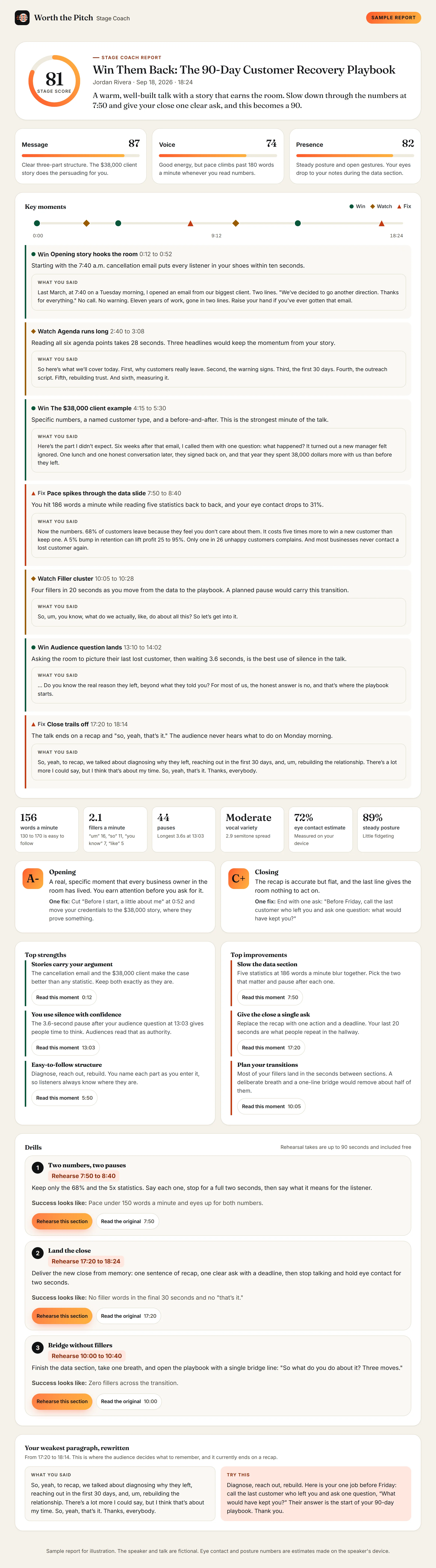
Here is what a Stage Report looks like.
This is the complete report from one 18-minute rehearsal. It shows the notes a speaking coach would give, pinned to the second they happened, and the exact words the speaker used at each moment.
- 81 Stage Score, plus Message, Voice, and Presence
- 7 timed moments with the words spoken
- 6 delivery numbers, from pace to eye contact
- 3 drills and a rewritten closing paragraph
Drills and progress
Each drill has a Rehearse this section button that records a take of up to 90 seconds and scores it against the same rubric. Rehearsal takes are included at no extra cost, up to six per session. After two full sessions, Stage Coach charts your Stage Score and filler words across your last eight sessions, so you can see the habit change.
Your privacy
Your full video stays in your browser for replay and is never uploaded. Face and body positions are measured on your device and turned into numbers right away. Stage Coach receives those numbers, your audio for transcription, and up to six still frames, and deletes the audio and frames within 24 hours after the analysis. You can delete any session, or withdraw consent and erase everything, at any time. The speech practice section of our Privacy Policy has the details.
Sessions and pricing
| Option | What you get |
|---|---|
| Free trial | One 5-minute session on every account |
| Growth plan | 1 session a month included |
| Pro plan | 4 sessions a month included |
| One session | $12, never expires |
| Stage Coach add-on | $29 a month or $249 a year for 8 sessions a month, up to 2 unused sessions roll over |
To buy more, open Stage Coach and click Get more sessions, or go to the Plans tab and scroll to Stage Coach add-on. The Stage Coach help article walks through every step.
Put it together before your next talk
Record one full run-through this week. Read the report, pick two fixes, drill the sections it points to, and record again. Most speakers see their filler count and their rushed minutes drop within two or three rounds, and the talk starts to feel like theirs.
If nerves are the bigger issue, pair this routine with our guide on how to calm nerves before public speaking, and keep a talk map ready using what to do when your mind goes blank.
Try Stage Coach on your next talk. Every account includes a free 5-minute practice session with a full coaching report.
Start your free practice session